
Story or Concept Video? What's the Difference?
Jul 9
/
Rance Greene
Isn't a video a story?
Sometimes stories are produced as videos, but all videos are not stories. There are various video types, most fall into one of two categories: stories or concepts.
Story-based videos
Stories are exactly what you think they are. You listen to, watch, read and tell stories everyday. What do all stories have in common?
Characters in conflict.
Characters in conflict.
A story-based video for training begins with relatable characters who encounter one moment of conflict after the next, until the story reaches the height of conflict. For training stories, this is where the video ends, leaving the learner with a desire for resolution and, more importantly, open to receive training.
You can write a story-based video in the form of a fill-in-the-blank story premise:
You can write a story-based video in the form of a fill-in-the-blank story premise:
-
"A story about Collin, a manager, who is struggling to conduct effective one-on-ones with his direct reports."
-
"A story about Jasmine, a sales rep, who is struggling to obtain and use competitive intelligence according to the company guidelines."
-
"A story about Amelia, an instructional designer, who is struggling to create performance-based training."
The video opens with Collin at his desk. Natalia, his direct report, enters the office for her one-on-one, but Collin is still finishing a report for his manager. Natalia knocks. She knocks again. Collin finally turns to see her. "Oh Natalia! Hi, what's up!" Natalia looks around. "Um, I'm here for my one-on-one." "Right! Come on in, I was just finishing a report for my manager."
The conflict begins to mount and continues to grow throughout the video as Collin continues to make one mistake after the next. The story unfolds in real time and ends at the height of discomfort.
The conflict begins to mount and continues to grow throughout the video as Collin continues to make one mistake after the next. The story unfolds in real time and ends at the height of discomfort.
What about stories with no conflict?
Hm. Have you watched a conflict-less story before? Probably in an eLearning course. How long did that keep your attention? It seems that many things are often called "stories" that really aren't. I stick with my definition of what makes a story a story: Relatable characters in strong conflict. A series of events where everything goes smoothly? Not really a story. The characters in these kinds of videos aren't relatable. The action seems unrealistic. The viewer loses interest and checks out. Not really worth the effort to produce it.
Stay the course and make a story-based video a real story.
Stay the course and make a story-based video a real story.
Concept-based videos
There are three main types of concept videos, but they all have one thing in common: the primary purpose is to help the audience understand (and take action on) an idea.
There are three main types of concept videos.
There are three main types of concept videos.
Explainer videos
Displays the action of an abstract concept.
Sample Topics:
"What is Empathy?"
"Adopting AI"
"The Benefits of Servant Leadership"
"What is Empathy?"
"Adopting AI"
"The Benefits of Servant Leadership"
Process videos
Displays the action of a logical sequence of steps.
Sample Topics:
"3 Steps for Reporting a Compliance Issue"
"Checkout Process for Patients in the ER"
"3 Steps for Reporting a Compliance Issue"
"Checkout Process for Patients in the ER"
Promotional videos
Displays the value of a product or service.
Sample Topics:
"An Event You Don't Want To Miss!"
"Our Company Can Help You"
"Our Company Can Help You"
Though concept videos can have strong story elements (characters and conflict), they are usually not a traditional story (characters involved in a series of sequential scenes in real time).
An important distinction between concept and story-based videos is the direction of the conflict.
Story-based videos progress towards conflict. As the video plays, the tension increases. In a concept-based video, the tension is high at the beginning and the action progresses away from conflict toward resolution.
Story-based videos
Conflict increases
Concept-based videos
Conflict diminishes
Concept videos show how things are now for the viewer:
-
Leaders lack empathy and people are leaving their teams.
-
Employees are reporting compliance issues to the wrong people, putting the company at risk.
-
Potential customers are struggling with a problem that could be solved if they attend your special event.
But, as the video progresses, the concept is revealed and brings resolution. We see what things can be like. That contrast between "what is" and "what could be" is a powerful motivator.
The video below is an example of promotional video for the Vyond courses here at the School of Story Design (shameless plug) that shows the progression from conflict to resolution. Notice that it does contain relatable character in strong conflict, but the purpose of the video is to promote courses. It fits squarely in the category of concept-based videos.
The video below is an example of promotional video for the Vyond courses here at the School of Story Design (shameless plug) that shows the progression from conflict to resolution. Notice that it does contain relatable character in strong conflict, but the purpose of the video is to promote courses. It fits squarely in the category of concept-based videos.
Write your awesome label here.
The characters are experiencing a lot of conflict at the beginning of the video that echoes the conflict of the viewers. By the end, they are dancing!
Did you also notice the other assets in this video (besides characters)? Every object, every piece of text in the video was carefully selected to demonstrate the action of the narration. For instance:
Write your awesome label here.
The graphics of the eye, brain and paper and pencil represent the action of visual thinking and storyboarding, skills students learn in Vyond Level 2.
Write your awesome label here.
The video of the nurse and the paper on the right demonstrate the action of providing feedback on the student's work.
Write your awesome label here.
The words and graphics represent the action of creating a concept video or a process video.
Write your awesome label here.
The virtual call shows the action of Rance (me) mentoring a student in the Vyond Level 3 course.
Which type of video should I create?
The type of video you choose is solely based on the purpose of the video.
If the purpose of your video is to train people, use a story that builds up the conflict and end at the height of the conflict. Your learning audience will be primed for training. To learn how to train based on a story, check out How To Humanize Training the Story Design Way, another quick read!
If the purpose is to explain an idea, process or value, write a concept video script that progresses from conflict to resolution. It's okay to use characters in a concept video. They can even talk. But you can also use objects and text (keep text minimal) to show the action of the narration.
If the purpose is to explain an idea, process or value, write a concept video script that progresses from conflict to resolution. It's okay to use characters in a concept video. They can even talk. But you can also use objects and text (keep text minimal) to show the action of the narration.
Master both types of videos
Take the first of three levels of Vyond training: Vyond Story Production to get started.
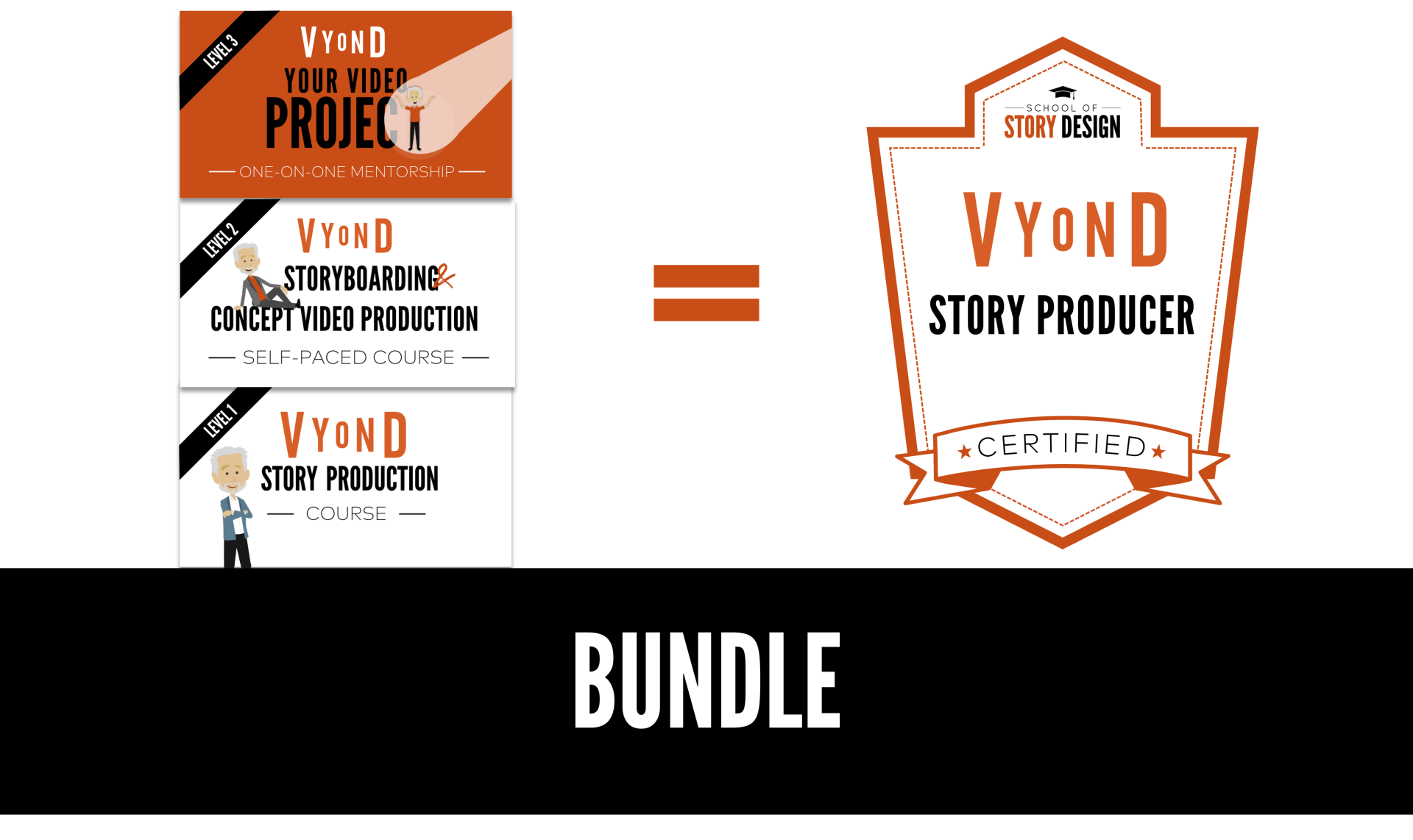
You can also register for all three levels at once...for less!

Training comes to life at the School of Story Design. Instructional designers learn how to write, produce and train with stories for meaningful learning experiences.
Copyright © 2026
Reminder emails are coming your way!
Created with