Recently, Luis Malbas, a friend and fellow designer, asked me, "What risks do you see if IDs lean too heavily on AI-generated content?"
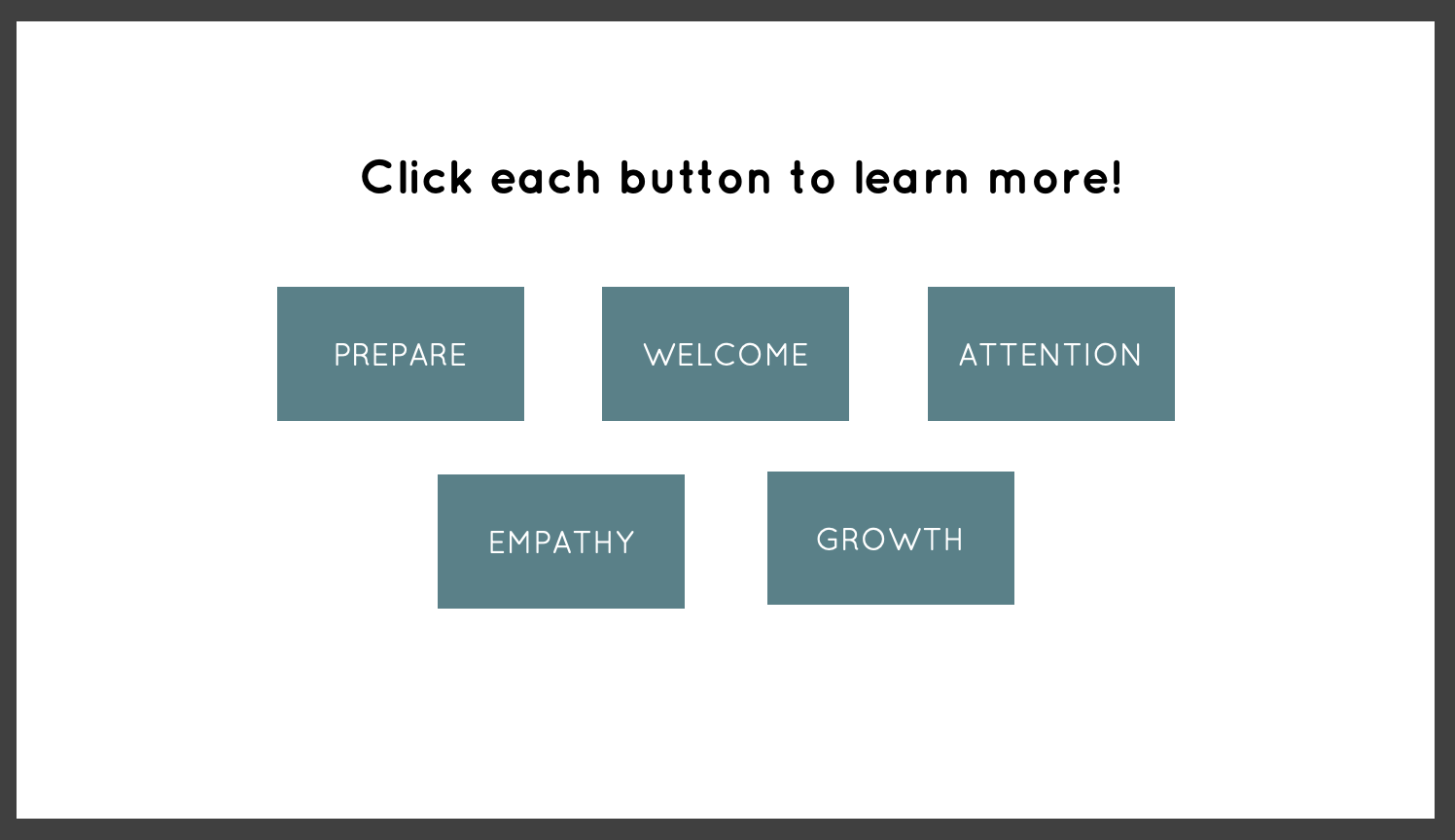
To answer this question, let's look at a common example of training that utilizes artificial intelligence to generate content. In this course, managers are learning how to conduct a one-on-one with their direct reports. It's an elearning course.
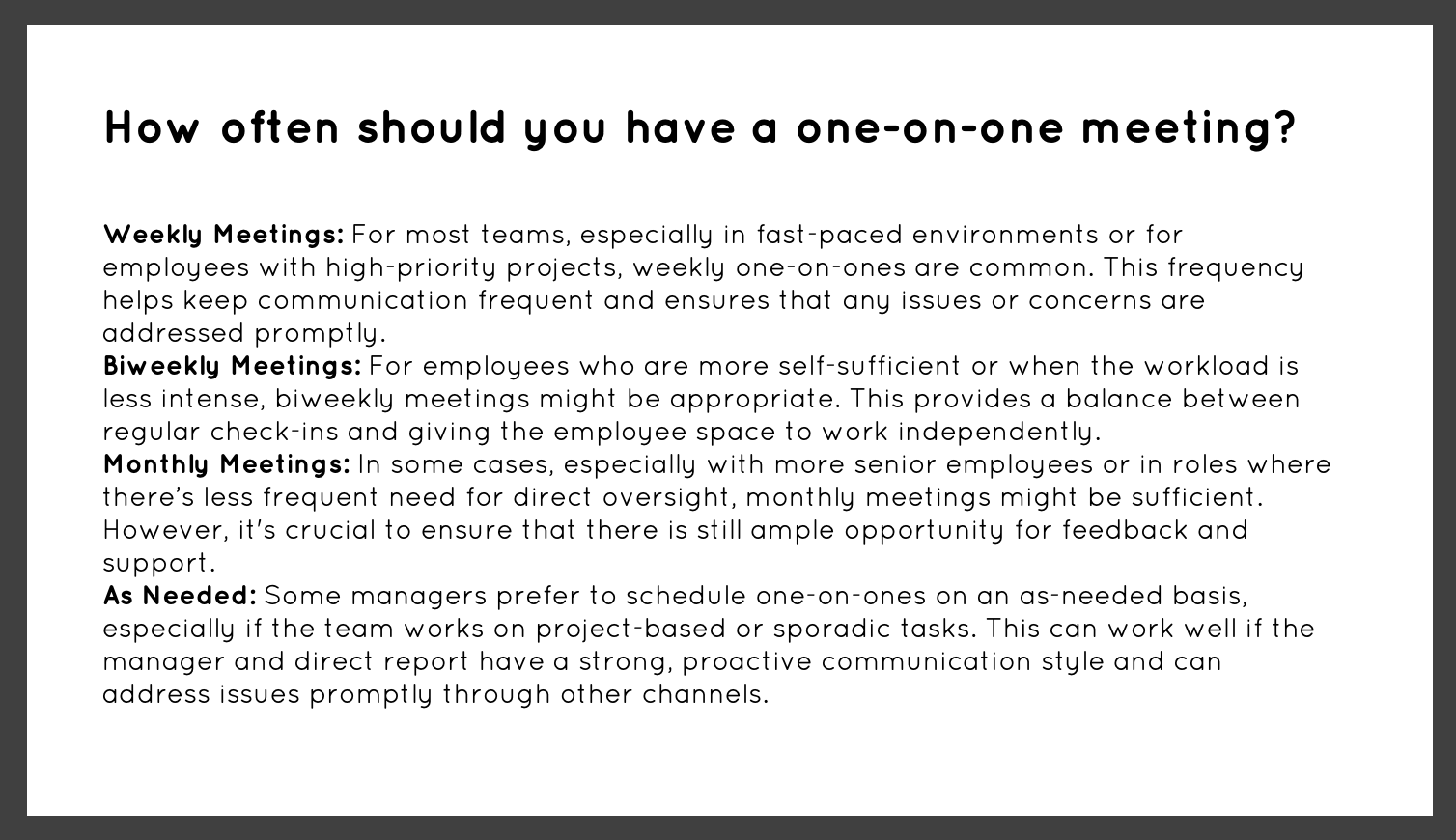
In case managers don't know what a one-on-one meeting is, artificial intelligence generates a concise definition and a picture.
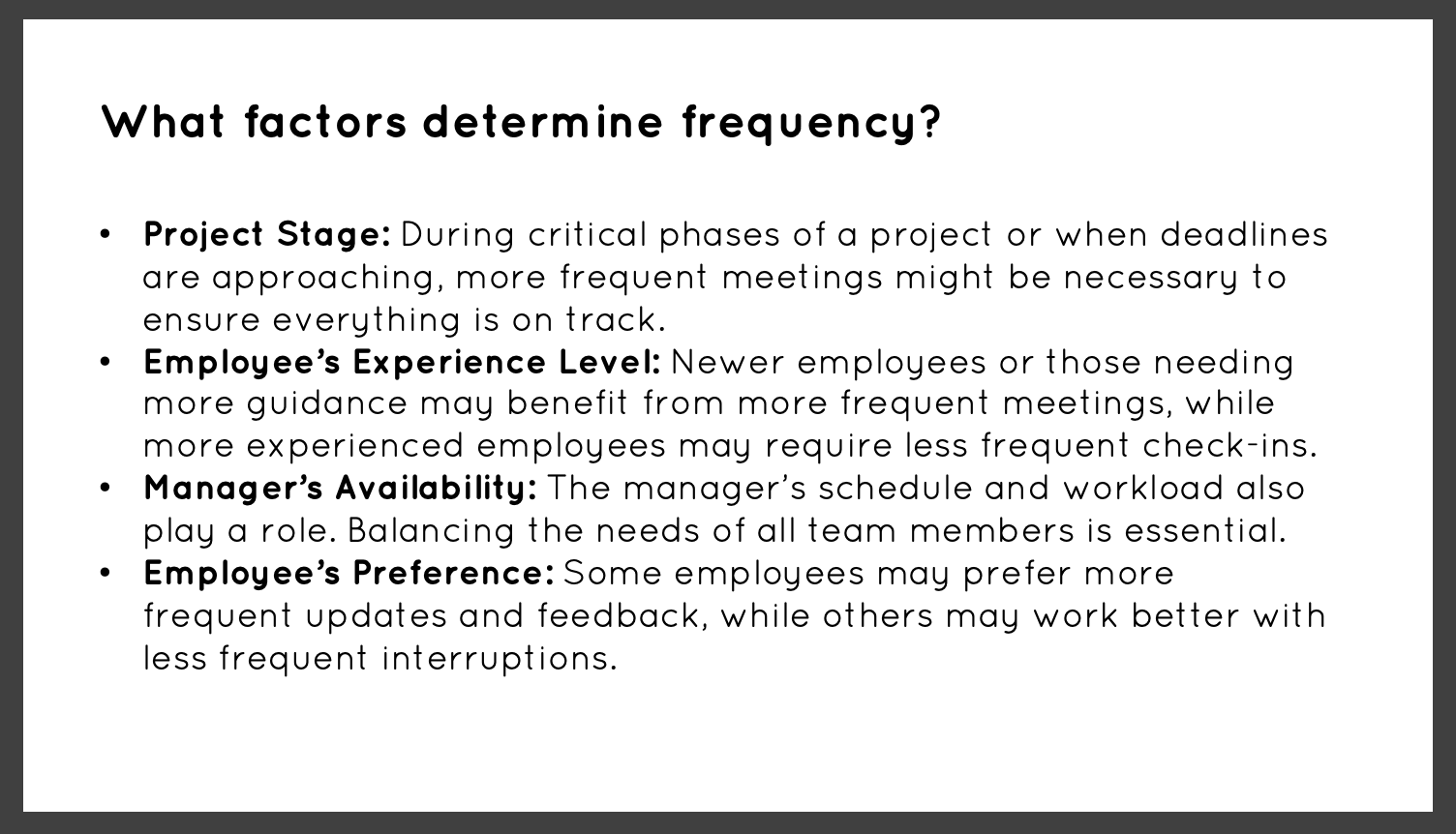
Exciting insights all generated by artificial intelligence tools.
Are anyone's eyes glazing over yet?
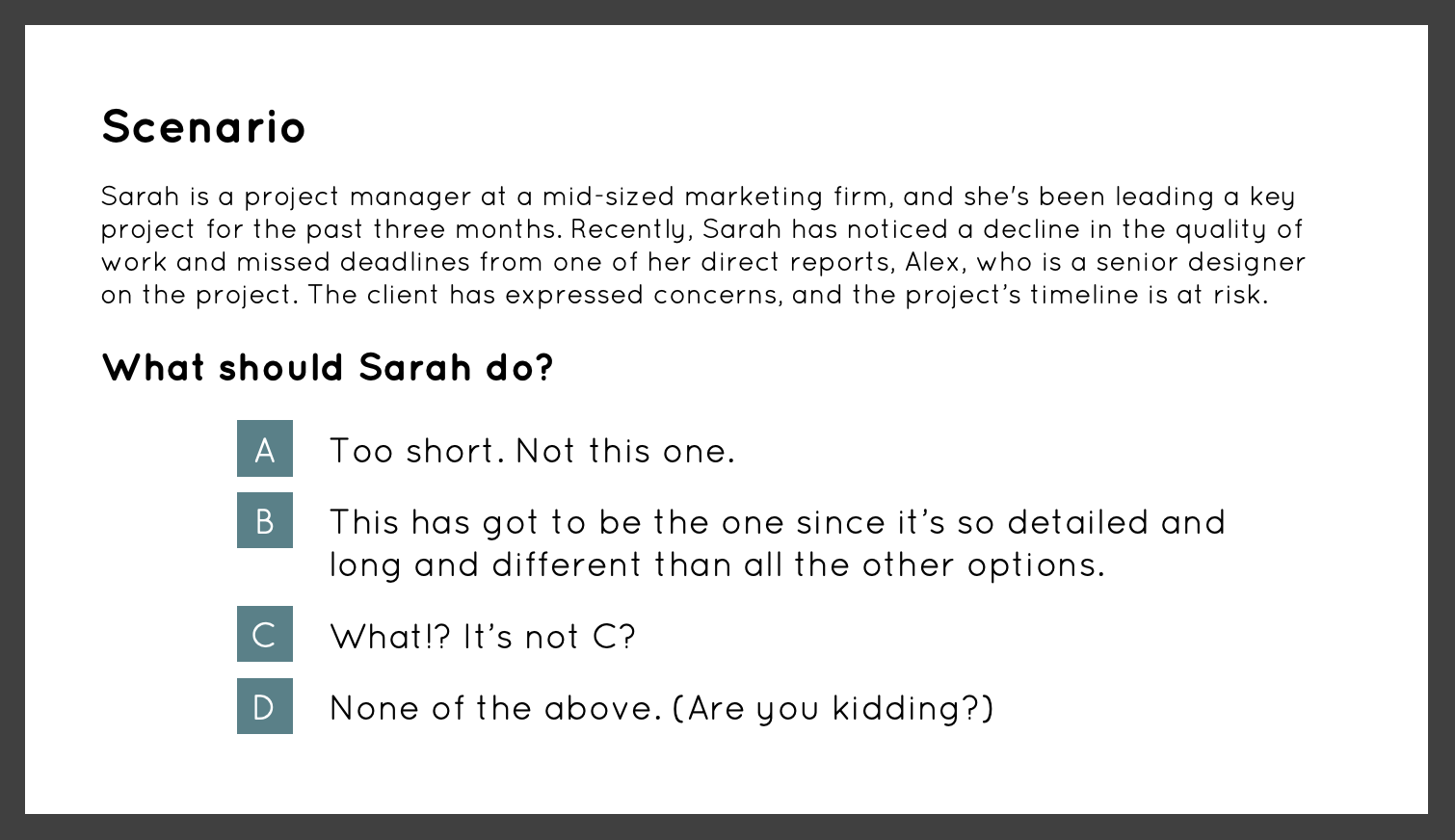
A scenario with an obvious correct answer.
Insert twenty or more of these types of slides, then...
Don't lie. You've experienced a course like this before. Maybe you even created it. If you ask yourself, "How do I feel when I'm taking this course?" what words come to mind?
-
Numb
-
Bored
-
Disrespected
-
Like I wasted my time
-
Why do you feel this way?
Possibly because it was an exercise in reading, not thinking. The course didn't give you any practice conducting a one-on-one and you feel about as prepared to meet with your direct reports now as you did when you started.
Training like this often holds content in higher regard than the humans it was designed to help. Common characteristics of this kind of training are:
Yet so much training looks a lot like this.
Before passing the blame off to AI tools, let's take a moment to reflect on the outcomes of the training by asking three simple questions.
Do I demand that learners think deeply or just enough to pass a quiz?
RISK #1: Critical thinking is not required.
If learners aren't challenged to make inferences, solve problems or figure things out on their own, the design of the course has deprived them of critical thinking. And, likely, the designer has deprived themselves of it too. It takes critical thinking in the design to produce a learning experience that requires it. Don't surrender critical thinking to someone, or something, else. Embrace it. Your real intelligence is more able to create humanized problem-solving activities than artificial intelligence.
RISK #2: Expertise is not required.
If learners aren't emerging from a training experience highly skilled, or at least more skilled than when they started, the design of the course has deprived them of expertise. Too often, learners are perceived as consumers of content. But content is easy to come by. Pretty much anyone can gather it and present it in a reasonably accessible way. You can see where this is going, right? Consumers need content. Content is easy to get. Why do we need an instructional designer? Consuming content does not equal expertise. If learners never gain proficiency, if they don't perform better on the job, it's likely because the instructional designer relinquished their own expertise to design training that produces experts. Don't be fooled. If you view training as content and your learners as consumers, it's easy to replace you. It's not easy to replace an expert.
RISK #3: Accountability is not required.
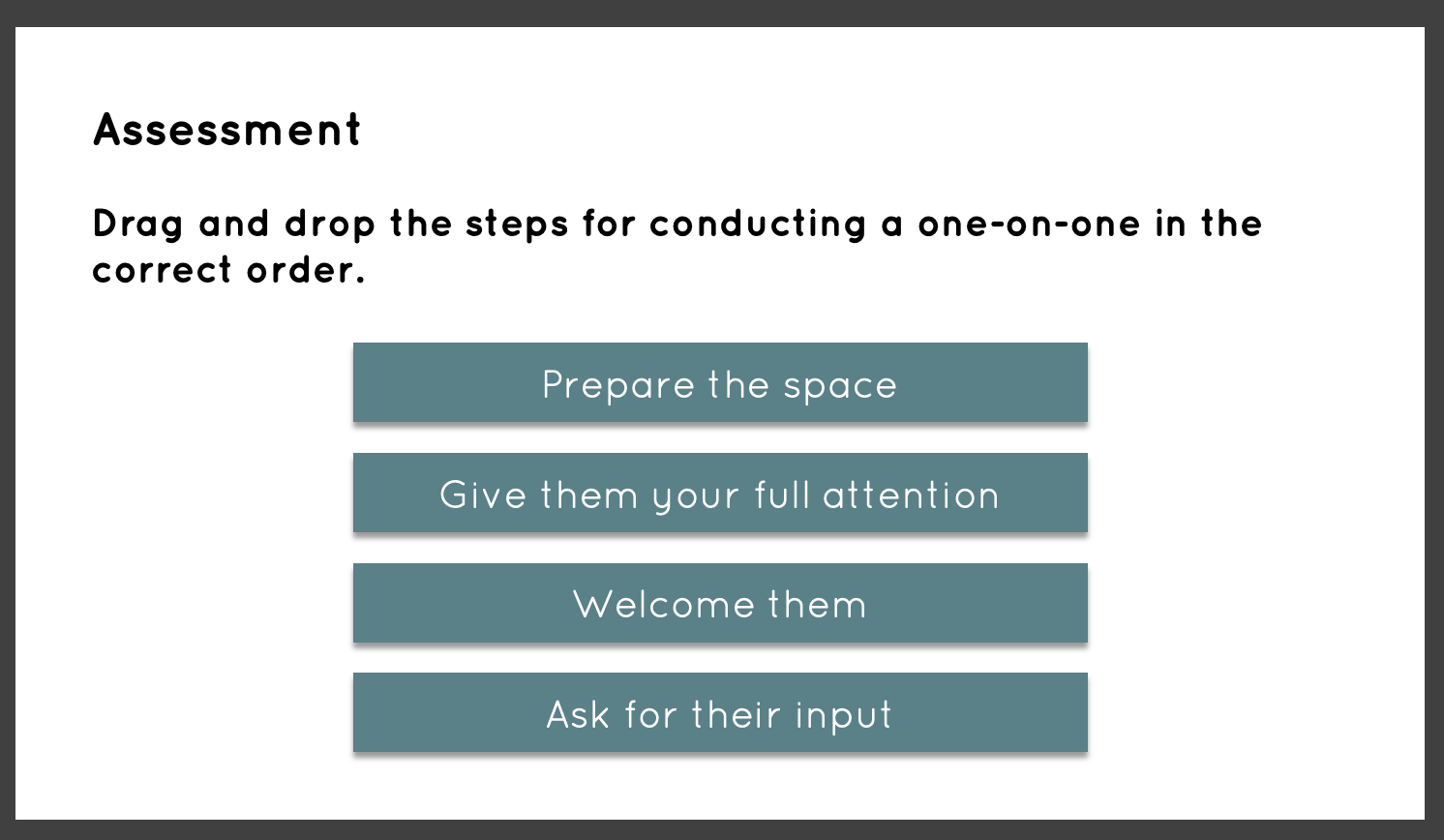
If learners are never given the opportunity to practice their new skills, the design of the course has deprived them of accountability. How often have you heard stakeholders say, "They just need to know...."? It's our privilege and responsibility to hold stakeholders (and ourselves) accountable. Ask them, "They need to know...so they can do what?" Make a list of observable actions that people to do. Give them opportunities to do those actions and give them detailed feedback on their work. Practice in training. Perform at work. No director is going to ask one of their managers to put the steps of conducting a one-on-one in order. They're going to ask them to conduct a one-on-one with their direct reports as they've been trained to do. As a designer, you can hold yourself accountable to design for performance.
Empty space, drag to resize
So, is leaning too heavily upon artificial intelligence tools the culprit? It could be. It could also be laziness. Or lack of training in instructional design. Or lack of time to devote to solid analysis or design or development. But there is an answer:
When you're tempted to give in to one of the three risks and offload critical thinking, expertise or accountability onto Chat GPT, remember what you're giving up...and the downstream impact on the learners.
Instructional Story Design humanizes every aspect of the process, from interviewing stakeholders to designing the course.
There's a great deal of pressure to use AI tools to do your work. If they are viewed as a non-human collaborator, and not a replacement for critical thinking, expertise and accountability, they may prove to be helpful.
Lean in to your own intelligence
If you are struggling to connect with learners and you just need some guidance to get started, join us for the next cohort of
The Instructional Story Design Experience. You'll get practice with every step of the process--from interviewing stakeholders to developing a story-based course, using a case study.
Take a sneak peek inside Rance's book,
Instructional Story Design, an ATD Press best-seller. Join thousands of other IDs who are taking their training to the story level!
L&D Teams, bring Instructional Story Design to you!